|
The
archaeological zones of Tula and Teotihuacan are only about an hour
apart, and the much smaller site at Tula can be visited in about half a
day. It is also a much less visited site, yet contains a very
informative museum. Other than a busload or two of well behaved
students, there were only a handful of visitors besides ourselves.
Located little more than an hour from San Miguel we decided to
visit Tula first before heading over to nearby Teotihuacan where
accommodations are more plentiful. It also felt quite laid-back and we
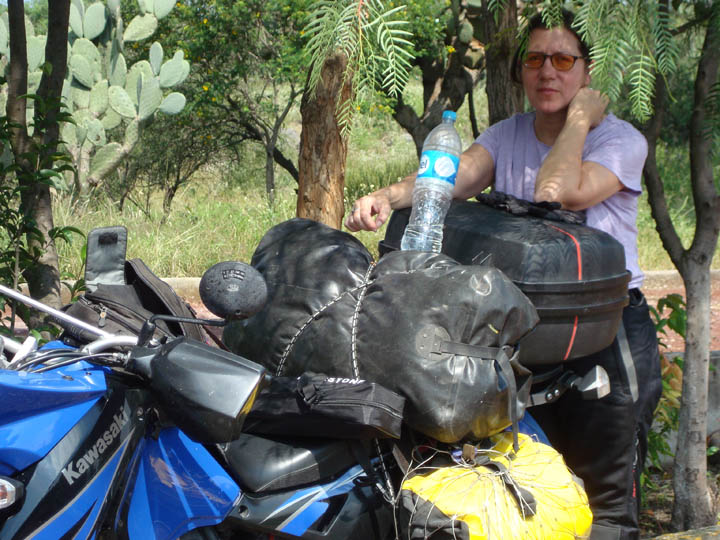
were completely comfortable to leave all of our gear on top of the
bikes while we spent a couple of hours doing a leisurely tour of the
site. A security person in the parking lot was more than willing to
keep his eye on our gear even without the gratuity that we had to
insist he take.
|

|
|
The
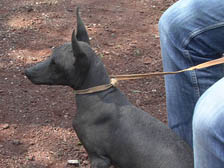
watchman's dog took an immediate interest in Karen's riding boots. At
top right is a better view of this archaeologically appropriate
companion. Typically having a completely hairless gray leathery skin
the xoloitzcuintli or xolos as they are now known have only a few stiff
bristles at the back of the head that stand up when the dog is in a
defensive mode. They also have a small tuft at the very tip of the tail
. The breed predates the Aztec period and indeed their name is made up
of two Nahuatl words Xolotl, which means god
and itcuintli or dog. There is some evidence that the dogs were also a
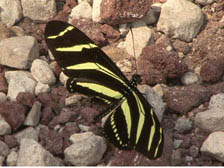
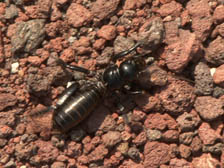
source of protein. This one also took a playful interest with these
interesting and ubiquitous butterflies as well as these 3/4 inch long
ants. The butterflies were identical except for size with some we
encountered in Taman Negara in Malaysia. At seven to eight inches
across, those butterflies were nearly twice as big as these.
|

|
Experts
are divided on the history of this site, but it is considered to be the
capital of the Toltec empire. There are many architectural similarities
to the much more well known site of Chichen Itza located in the Yucatan
some thousand land miles away. What complicates the issue is that
Chichen Itza flourished during the Late Classic and Terminal Classic
Mayan periods (600 -900 CE), while Tula, or Tollan as it is sometimes
known, served as the capital around 980 of the current era after the
much larger nearby Teotihuacan. Tula met its demise in the latter part
of the 12th century CE, giving rise to the question of which direction
these shared features traveled. The many columns, like those below,
bear striking resemblances to those at Chichen Itza.
|

|

|

|

|
Like a similar
area found at the Chichen Itza site, this grouping of columns at left
would indicate an area that once supported a stone roof. In the museum,
this bench-like ceremonial altar, or chacmul
is just like those found at Chichen Itza right down to the
bowl-like recess in the stomach thought to be used to hold the
sacrificial heart. I need to point out that I have been visiting Mexico
for some 40 plus years now, and after attending college for the first
time in my early fifties my studies in Anthropology have given this
country some very new meaning for me. So if I appear to ramble on and
on about things archaeological, or about indigenous peoples, it is more
of a case of trying to place these things in some sort of frame of
reference for my own failing memory, than to be a source of information
for anybody or anything. Like any of the free information to be found
all over the internet, you are getting exactly what you pay for.
|

|
After settling
in in the town near Teotihuacan, we decided to begin our visit as early
as possible the next day. We were unaware of this method for gaining an
overview of the site, but in the early morning calm we found ourselves
quite envious of the folks enjoying this approach. The balloons do help
give an element of scale to the photo though. The Pyramid of the Sun is
the largest structure at the site. I recall several years ago the
anthro community was in an uproar when Walmart had announced plans to
locate one of its big box stores less than two mile from this site.
Despite the valiant effort, the parking lot is clearly visible from the
top.
|
|
|

|
This view of
the pyramid of the moon is taken from the top of the pyramid of the
sun. It enjoys a place of prominence at the head of the Calzado
de los Muertos (Avenue of the Dead).
|

|
The
view down the Calzado from
atop the Pyramid de la Luna shows the symmetry of the adjacent
structures. In the photo at right below are the altars as they are seen
looking down from the Pyramid of the moon. They are mirrored on the
opposite side of the calzado.
They are considered the classic examples of the talud and tablero architectural
style found throughout mesoamerica. The other photos are some of the
many friezes and glyphs that can be seen all along the calzado. They
are (counterclockwise from top left) the jaguar the serpent's head and
a feathered ceremonial mask.
|

|
 |

|

|

|
The many
amazing artifacts on display in Teo's sprawling museum are simply too
numerous to mention. This assemblage depicting Teotihuacan's
agricultural deity is just one meager
example.
|

|

|

|
|
|
|
Across
from the museum the delicate and painstaking process of new
excavation is an unending endeavor at Teotihuacan (top left). The town
itself is not without its own beauty. Above we were able to find an
enjoyable spot for a picnic, and the town was also apparently known for
its creative confections (bottom left).
There were several bakeries with glass display cases in the front of
the store vying for the pesos of hungry passers-by. Avery handsome
Mexican style roast chicken unfortunately was unable to linger long
enough for its photo session.
|
|

|

|
|
|

|