 |
|
|
I mentioned earlier that there
are two Guatemala's, the gritty urban Guatemala that has grown up
around the main Interamerican arteries, and the beautiful and relaxed
Guatemala that is the heart of the country. As soon as we left the main
highway to head east from Huehuetenango the difference was immediately
obvious. If you wanted to take a picture you can just stop the bike,
get off and walk over to the edge of the road and take your picture
with
little risk of obstructing any traffic. The landscpe was breathtaking
in its simplicity.
|
|
 |
|
| We rode
through rolling hills and verdant valleys dotted with simple
farmhouses. The road was beautifully paved on its western stretches,
but we knew form our visit in 2009 that the eastern portion had been
wiped out by a massive earthquake in, I think 2004, and because of
recent seismic activity it had now become even more unstable. During
that visit we had only to ask locals if the bus was going from Coban to
Huehue. We figured if the little combis could make it we could. The
road
had tumbled some 1000 meters to the valley floor below. After some work
with bulldozers, people just continued riding over the debris pile
until it was level enough to drive on. It was getting to the bottom
that was the tricky part. |
|
 y
part y
part |
|
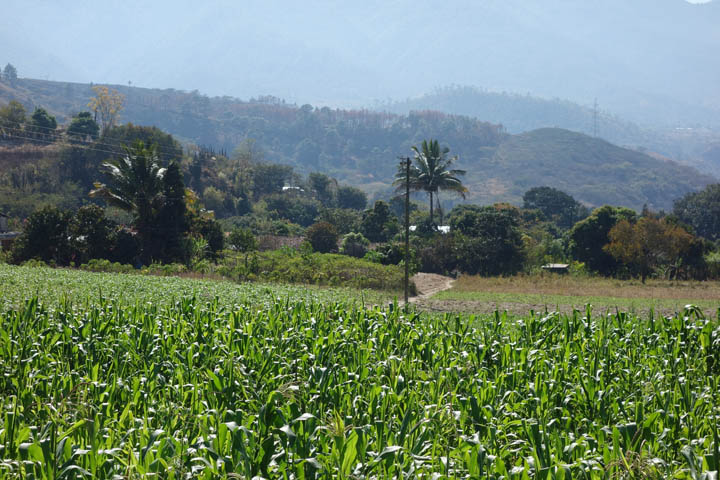
| Even
in the handful of towns and villages that we passed through almost no
home was without the ubiquitous milpa--the
cornfeilds that are the life blood of the indigenous people. In the
Mayan culture corn is elevated to the level of the sacred, and it is
used for every manner of food and drink imaginable. |
|
 |
|
| The milpa is so important to the
survival of the family that it is everyone's responsibility to nurture
it and make it grow. If you click on
the image above, you will see just how difficult the work really
is. |
|
 |
|
| One
of the things I found refreshing about traveling through this part of
the country is, although the paved road was relatively new and of
excellent condition, when it came to the perfectly useful and
substantial stone bridges from the days when this was just a graded
dirt road the traffic would slow to accomodate the fact that it was
only one lane wide. It was neither too difficult or too much of an
inconvenience for people to exercise a little courtesy and cross the
bridge one at a time. This was something also true in towns. Rather
than put up stop signs at small intersections they put up signs that
said uno y uno. What a
concept--one at a time. |
|
 |
|
|
As you begin to descend from the
higher elevations to the valley just above Chichicastenango the
panoramas are awe inspiring.
|
|
 |
|
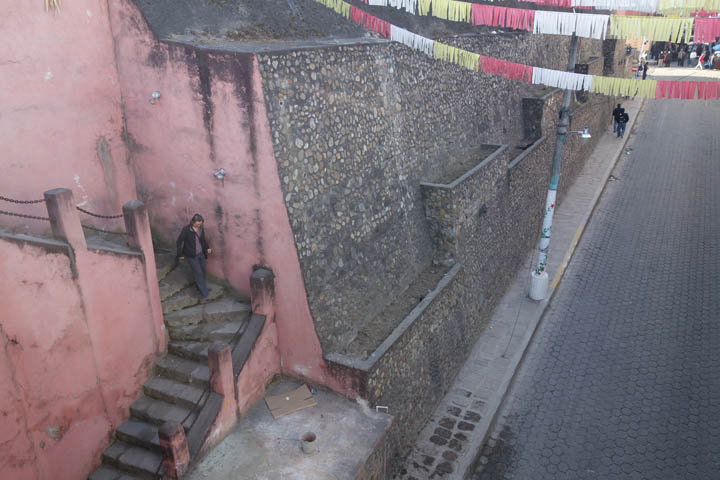
| Our pleasant little hotel in Chichicastenango was on the street above one of the town's most notable landmarks el Arco. The road coming in to town passed below the arch and Karen is seen above going down from the top of the arch to the main road. | |
 |
|
| Some
of the streets were so steep they reminded us of Sarganaga--a stretch
of teacherous cobbled road that we stayed on in La Paz, Bolivia.
Turning in and out of the parking had more than once been Karen's
downfall. |
|
 |
|
| The
best reason to come to Chichi though is to experience one of the twice
weekly market days. It is an explosion of color, and we arived just in
time for Thursday's market. |
|
 |
|
| This
is not merely a show put on for tourists though, and local women come
to haggle over everything, especially these massive skeins of
brightly colored yarn that is used on their hand embroidered work. |
|
 |
|
| Locals
come and go on transportation that is as ubiquitous as their milpas. They are retired rural
school buses from the United States. Brightly colored and ornamented,
they are commonly refered to here by tourists as Chicken Buses. |
|
 |
|
| I
don't know why they call them that. |
|
 |
|
| We
had the benefit of arriving on a religious feast day, and we were
treated to processions by local cofradias--fraternities
of men from
different neighborhoods that led small groups to the local church
playing simple instruments and burning sweet copal incense along the way. |
|
 |
|
| As bustling as the
crowd becomes, the local women seem always to be cognizant of their
surroundings and immediately bow their heads or avert their eyes when
they see a camera come out. |
|
 |
|
| The
men of the cofradias, while reserved, seem a bit less reticent about
being photographed. In the photo above they carry by hand images of
their group's patron saints on heavy carved "floats". |
|
 |
|
| Women
sell flowers and candles on the church steps above which are layed and
burnt in offering at the church door below. |
|
 |
|
| As
the day wears on tour buses begin to arrive from Panajachel and Antigua
and the initial asking prices become rediculously high--as much as 5
and 6 hundred percent over what they would actually take. If you bite,
fine, but if not they ask what you want to pay. If you offer half of
what they were asking they act really insulted. Offering them 20% of
what they were asking will get them bargaining in earnest. We bought
four tzuls--they are the embroidered headwear worn by the men with
tassles at the corners. They of course were of varying quality, as many
of those being sold are quite old. The older ones are most often the
best quality. Asking prices were anywhere form 400 to 1500 quetzals.
The first cost us 400 the next was 260 and the third and fourth we
bought from the same man for 190 and 160. We watched people pay as much
as 1000. |
|
 |
|
| Even
the sun joined in on the riot of color. I couldn't have made this
rainbow lens flare again if I tried. |
|
 |
|
| With the town
becoming inundated with tour bus types, we escaped to the garden of
Chichi's nicest hotel for an espresso. In the afternoon its feathered
denizens have their cage doors opened and parrots and macaws compete
for the attention of tourists. |
|
 |
|
| Everyone
gets in on the act. At the edge of town where the tour buses discharge
their passengers, tuk-tuks festooned with displays of balloons line up
in waiting for the next wave of shoppers. |
|
 |
|
 |
|
 |
|
 |