We arrived in
Guanajuato just in time for the Cervantino Festival. This
festival of theater, arts, and astronomy is named for the
Spanish author of Don Quixote. It is Guanajuato's largest
festival, and perhaps the largest festival of theater in
all of Mexico. The town literally packs to the rafters,
and we were fortunate to get a rooftop garret for one day.
Couple this with the fact that almost all of the main
arteries in Guanajuato are subterranean, and the few main
thoroughfares that traverse the city above ground are
one-way, and you are faced with a traffic nightmare. The
tunnels that honeycomb the lower reaches of the city were
created to divert water following devastating floods in
the latter half of the 18th century. These floods had
nearly wiped out the town's center. In the 1960s, work was
begun on a dam to relieve the flooding, and the tunnels
became the underground streets and callejones that
they are now. Guanajuato definitely requires considerably
more than the one day we were able to spend there, but the
Cervantino festival draws people from all over the world,
and there was simply not a room to be had any where in the
whole town.
|

|

|
Adding to the traffic
situation is the fact that the main one-way
street that runs adjacent to the central plaza at left
above becomes a de-facto pedestrian mall for most of the
evening hours.
|

|

|
The relatively small
colonial center is actually home to a number of elegant
theaters. Perhaps the most dazzling of these is Teatro
Juarez which is impressive by day but simply sparkles by
night.
|
|
|

|
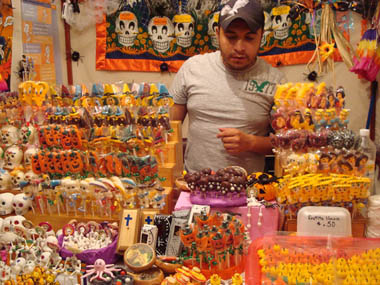
Mexico's
famous Dia de los Muertos was also rapidly approaching,
and by evening all of the town's small plazuelas were dotted
with candy stands, which in addition to the traditonal
sugar calaveras
(skulls), were also selling candy jack-o-lanterns and
Sponge Bobs. Mexicans kids have embraced Halloween in
addition to their two day Day of the Dead and Todo Santos
on November first and second, complete with a three day
equivalent of trick-or-treating. Meanwhile by day, as the
evening's revelers rested, many signs remained of the
town's mining heritage such as this mining cart cum flower
box above right.
|
 |
Fortunately, San Miguel Allende is
only about an hours ride from Guanajuato, and rooms
were a little more readily available there. San Miguel's
manicured square was equally inundated with Dia de los
Muertes activities. San Miguel has long been a favorite
with gringos, and in particular gringa tourists,
and it was not uncommon to encounter groups of 5 to 10
"women of a certain age" that were traveling together.
|
|
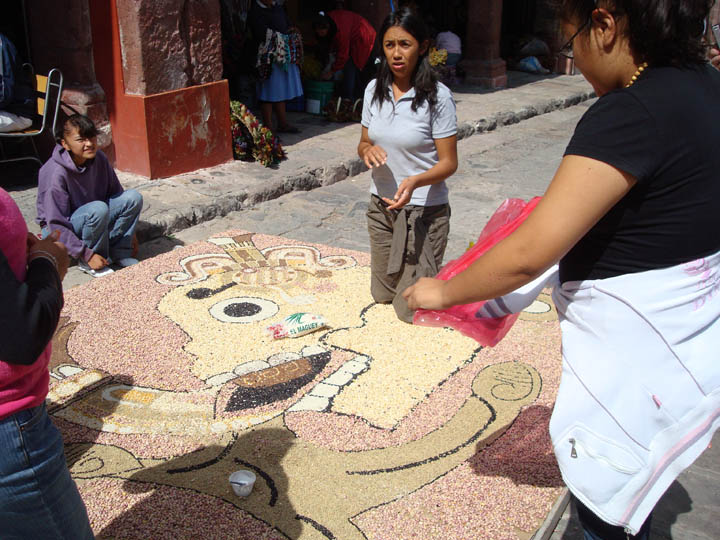
Is this a
comment on the transitory nature of art, or on its
permanence? The images above and below are centuries old
and constructed completely from different types of beans,
lentils, and rice. There were several teams that were
working by hand all around the square.
|

|
|
|
|
|
|
|

|
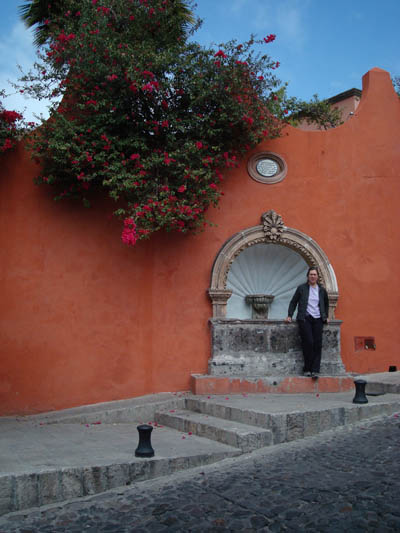
| We were able to find
a room just a little off the square in a former
convent (left). Best of all, unlike Guanajuato, we
were able to park the bikes off the street. As you
can see above the parking in San Miguel's narrow
streets could be a problem. |
|

|

|
Beauty can be found at every
turn in San Miguel. The photo at right is a close-up
detail of the doorknob on the door at left.
|


|
|
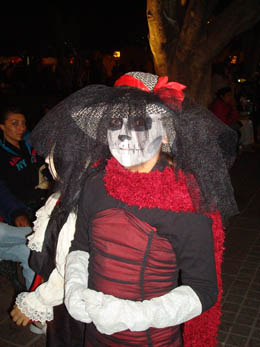
San Miguel's real beauty dazzles at
night.
|

|

|
|
|

|