Morelia
is the capital of the state of Michoacán, and while it is packed
with 16th century charm, it euxudes a very relaxed yet hip modernism.
Its name is an homage to the famed Mexican Independence leader
José María Morelos. Prior to independence it was known as
Valladolid after the famed Spanish city of that name.
|

|
As
is typical of most of the buildings of the period, Morelia's Cathedral
is built on a grand scale from large blocks of pink stone. Close
inspection can reveal a variety of architectural styles owing to the
fact that the Cathedral took just over 100 years to complete. It is
flanked by its own small plaza in the foreground, and by the Plaza de
Armas on the opposite side. Together they take up a full two city
blocks. It is equally beautiful and attracts crowds both day and night
(below).
|

|
On the street
adjacent to the Cathedral's plaza you can even hear a "hurdy-gurdy man" at night.
|

|
With
their impressive stonework, Morelia's colonial masterpieces do not have
an angle from which they do not impress. The garden beneath the bell
tower (below) is a popular meeting spot for both students and tourists.
|

|

|
The
massive wall at left is one side of the Palacio Clavijero. Beginning in
the mid 17th century it was home to the Jesuits until their expulsion
from New Spain in the 18th century. Since then it has had many
iterations, and currently it is technically a state office building but
its many salons are typically used for contemporary art installations.
Where the trees begin on the right there is a narrow strip running the
entire block known simply as the "Jardin".
It is home to a row of trendy outdoor cafes where students and office
workeres can be found quaffing pitchers of Micheladas. On our visit the Palacio housed an impressive
photographic collection of film directors from Spain, as well as a
display of prints depicting engravings from various editions of Don
Quixote over the centuries. Below are just a few.
|

|

|
The
print at right is from an edition from 1662.
|

|
The Jardin above is
quiet during the morning hours, but begining around 4:30 or 5:00 in the
afternoon it is teaming with people.
|

|
Inside, the
Clavijero's huge courtyard once housed a prison. Below, you can see
just how thick the walls are, and the artful use of architectural
elements needed to support them.
|

|

|
Although Morelia has
some amazing accomodations decorated with local artwork and antiques
for considerably less than $100, it is one of the handful of places
that we have visited where we feel entirely comfortable staying in a
hostel. This one caters to travelers of all ages, has a communal
kitchen, and allows us to pull the bikes into the interior courtyard at
night. Our bikes parked in front served as a billboard for this couple
fron Lake Tahoe who were traveling on KLRs. With breakfast included and
free wifi, the cable tv drove the price up to 30 bucks--the most
expensive room in the place.
|
|
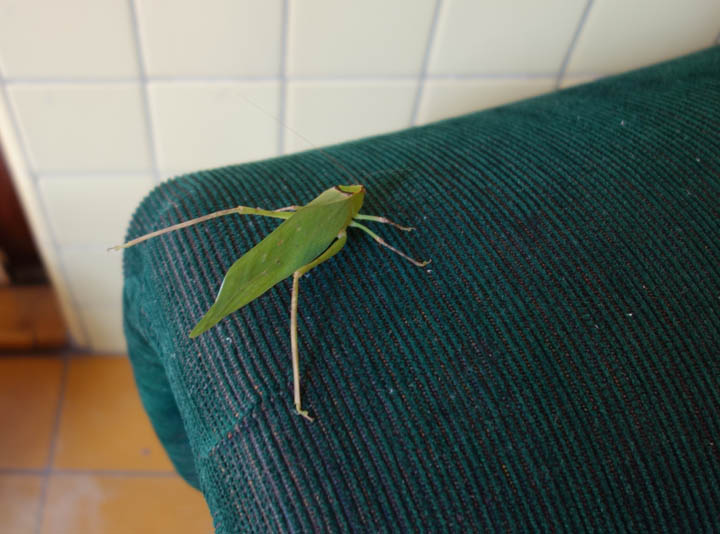
Although
the area around Morelia enjoys world fame as the southernmost home to a
massive annual migration of Monarch butterflies, this leaf-bug was the
biggest wildlife we encountered. To give it scale, the tiles in the
background are 4x4 inch squares.
|

|

|
|
|

|