| There is so much
that can be said about Pátzcuaro, its hard to know where to
begin. The fact that we arrived the day before one of their largest
festivals of the year--the December 8th festival of Nuestra
Señora de la Salud--only served to complicate matters. The
festival shares its name with the town's Basilica de Nuestra
Señora de la Salud which was essentially right across the street
from the Posada where we stayed. The festivities actually continued all
weekend long with fireworks processions and dances of all manners. |
|
 |
|
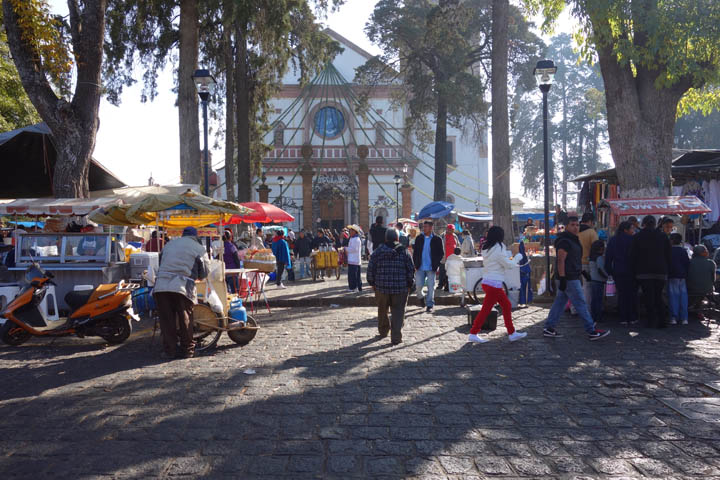
| The Plaza de la
Basilica wraps around the front and one side of the church and was the
center of most of the weekends activities. The fireworks, most of which
were just powerfully loud salutes shot high into the air, began with
the roosters at dawn and continued till well past midnight each day. |
|
 |
|
| We
never were able to determine whether it is by law or custom that all of
the buildings in the town's historic center maintained the same paint
theme. The bottom four to five feet were painted a red, not unlike the
Navajo red that many barns are painted in the US, and the upper portion
is painted white. The signs indicating the name of each establishment
also are uniform in that the first letter of every word is red while
the rest of the word is black. The building in the background above
looked not unlike the exterior of the Meson de San Antonio where we
stayed. That was where the similarity ended in that the interior was in
an elegant hacienda fashion. |
|
 |
|
|
The rooms in the hacienda
wrapped around a beautiful courtyard, and a light breakfast was served
each morning in a dining room furnished completely in handmade local
furniture (below).
|
|
 |
|
 |
|
| Amazing
Purépecha pottery, made by indigenous artists from communities
surrounding lake Pátzcuaro, decorate this antique sideboard off
the dining room (above) and the communal kitchen that had Karen & I
both drooling (below). |
|
 |
|
 |
|
| The
exquisite furnishing doesn't end inside, and all around the courtyard
were beautiful benches like this one, also hand carved by local
artists. Below left is a closeup of one of the arms, and the photo at
right is an outdoor linen dresser. |
|
 |
 |
 |
|
|
The handwork does not end with
the furniture but even the doors to the rooms showed elegant detail,
and each room had its own sitting area with a small hearth (below).
|
|
 |
|
 |
|
| Hardly a spot on the
courtyard walls were not covered with vases and the most beautiful
plants. And no, we are not going to mention how much this place cost. |
|
 |
|
| Other
planters are made from masks |
|
 |
|
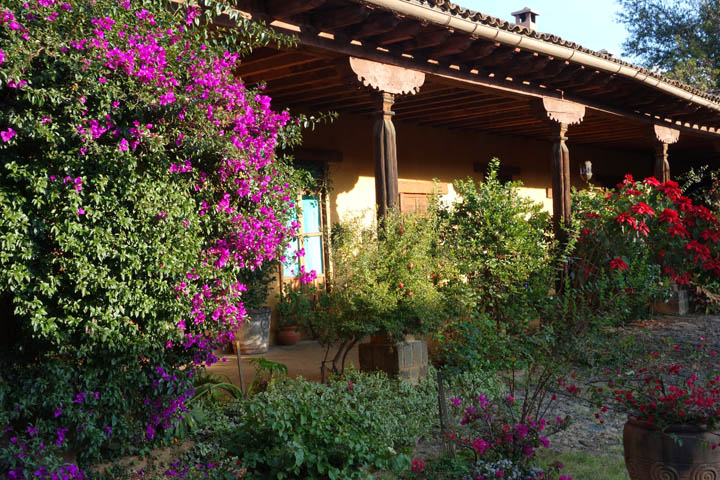
| Other
private residences are no less impressive. The one above is one of the
few that can be seen from the street; most utilize the hacienda plan
like our hotel that has the home surrounding a central courtyard. |
|
 |
|
| Back at the Basilica
things were heating up as the day wore on. The days activities included
many different traditional dances, and the dancers above and below were
getting ready for their big moment. |
|
 |
|
| That's right, the
horses dance too. I'm only sorry I can't load better quality video, but
my host only allows max uploads of 5mb at a time. Click on the image
above to watch them dance. |
|
 |
|
| Giant
puppets also performed a dance of their own. |
|
 |
 |
| Meanwhile,
around the plaza stalls sold everything imaginable from full meals, to
herbal remedies and to local sweets like the candied papaya shown at
left. Nobody seemed to mind the swarms of sugar bees that competed for
the dozens of different kinds of candied fruit and sweet nut brittles
being sold. Maybe it was the scores of religious icons being sold in
the next booth that protected everyone from stings. |
|
 |
|
| Later
in the afternoon a procession descended from the Plaza de la Basilica
to what's known as the Plaza Chica. This plaza is adjacent to--and
essentially part of--Pátzcuaros local market. We didn't stick
around to determine what exactly was the purpose of this procession.
This was mainly because on any given day both the market and the plaza
are teeming with people, and with the addition of this group it was all
but unbearable. |
|
 |
|
| Early
on the morning of the second day we were attracted by the sounds of a
marching band. It turned out to be this funeral procession. It was
interesting to us in that it was less an instance for mourning than it
was for celebration. Also interesting is that all of the attendees
follow the hearse on foot, only the deceased gets to ride. Once again,
if you click on the image above, you can get a brief example of the
music and procession. |
|
 |
|
|
Just wanted to put up one last
image before leaving Pátcuaro's main page to show a little bit
about the towns around Lake Patcuaro. This is obviously a place where
we could just go on and on, and believe me I am nowhere close to
running out of images. The one above is a craft that is practiced right
here in town, while much of the pottery and exquisite carved work comes
from Purépecha villages all around this region. The work being
done above is known as lacas. Lacas are finely crafted plates and boxes
made of wood, and laquered to a mirror like sheen and then
handpainted--frequently with images of birds--and trimmed in 24 carat
gold paint. As you can see it is a painstaking process, and smaller
plates are typicaally done under a large magnifying glass.
|
|
 |
|
 |
|
 |
|
 |
|