Before heading
south through the central highlands towards Mexico's Colonial "silver
cities" we had one last stop in Cuautemoc. Before departing
though I find it a little difficult to choose among the many images we
encountered around the Barancas, so if you haven't had your fill there
are a few more 'snaps' here. Although we
didn't really spend enough time around Cuautemoc to actually take any
pictures, it is the local people here who really warrant mention.
Cuautemoc is the center of Chihuahua State's large Mennonite community,
and the countryside is dotted with numbered "Campos" as the prosperous
Mennonite towns are called. It seems a little incongruous to see these
blond women in bonnets and ankle length dresses, and germanic farmers
in bib overalls and straw hats on their big John Deere harvesters. In
fact, I think I encountered more large farm equipment in this state
than I had in all of my previous trips to Mexico, and I have been
coming here for 40 years. The guide books seem to indicate that the
Mennonites are somewhat stand-offish, but we found the opposite to be
true. Perhaps it's the fact that we are on bikes that makes us the curiosity. We got off of the
highway on a bright Sunday morning to have breakfast at one of the
spotless Mennonite restaurants called La Huerta. When we asked the
owner for directions, he pulled up a chair at our table and ordered a
cup of coffee and began to draw us a map. We learned his name was
Isack Scmitt, and after a good half hour of talking local politics and
economics he instructed the waitress to tear up our check. For every
little hassle the road can throw at you, there is an Isack Schmitt that
makes it all worth while.
|

|

|
Having
bucked the wind on our ride across the central highlands, I remember
thinking that parts of it reminded me of Bolivia's altiplano. Parral's
location in a small depression or cuenca
protected it from the wind and completed the picture.
Although not nearly as large, steep, or dramatic, it is the same kind
of geography as La Paz in Bolivia. We got the picture at left, from the
La Prieta mine above the town. The mine is closed except as a historic
display for tourists. It was closed the day we were there, but a few
pesos greased the watchman to let us ride up to the top. This old
derrick like structure at right appears to be one of the oldest of the
many structures that remain. Untold numbers of indigenous slaves died
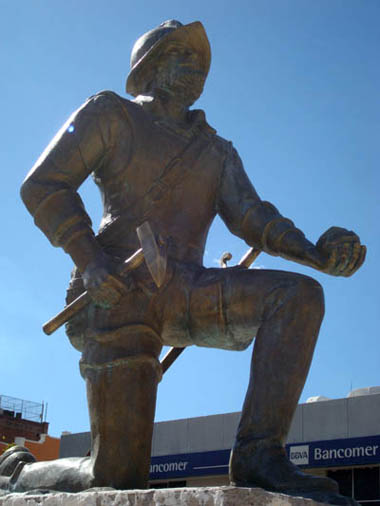
taking silver, copper, lead, and other minerals. The conquistador prospector (below) in
one of the town's two small squares stands as a reminder that Parral
owes its existence to those minerals. About the only other fame that
Parral can lay claim to is as the place where Pancho Villa was
murdered. While Parral's churches are nowhere near as spectacular as
those we would encounter in some of the other colonial cities, they do
project a certain solid and permanent air.
|
 |

|

|

|
Durango's Catedral
Basílica Menor, on the other hand, was more like the
spectacular
architecture that we would find in the wealthier "silver cities".
Durango, in fact was nothing like what we expected. Scores of westerns
conjured images of swaggering cowboys, and there remains movie sets
outside of town where John Wayne and others made some of the most
memorable films of our childhoods. Today's Durango though is a much
more cosmopolitan place, and even our hotel, on a pedestrian mall
adjacent to this cathedral, held an upscale Brazilian churrascaria in
its atrium. The police here even got around on Segway scooters below
left. Also below, Karen stands in front of our hotel. The management
had even offered to let us park our bikes inside a bar off of the lobby
that was being remodeled.
|

|

|

|
Even
ordinary residences in the neighborhood near Durango's cathedral can be
rather impressive.
|

|

|
|
|

|

