| Leaving
Durango we opted for another quick one-nighter in Zacatecas. It isn't
that Zacatecas doesn't warrant a longer visit, but we had enjoyed a
longer stop here on our 09/10 trek, and it was pretty well covered on
that trip. You can look up our recollections of that trip here. We did however look up an
old aquaintence by the name of Juan Antonio, an extremely energetic
artist who operates a restaurant with the unlikely name of "Lucky
Luciano's". I'm not kidding. The place is covered with hardly an inch
of space to spare with his paintings. He remembered us and on leaving
presented us with one of his prints. If you make it there look him up. |
|
 |
|
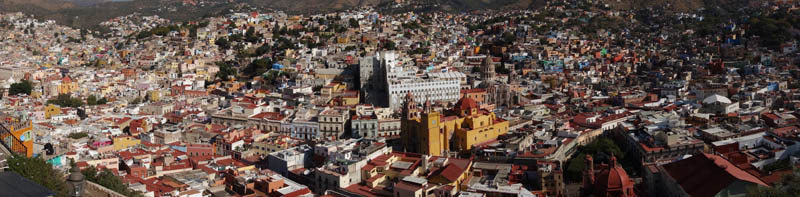
| The
panoramic view of Guanajuato is as good a place to start as any. On our
last trip through here the town was in the throws of its annual Festival Cervantino. This
international celebration of theater with a side of astronomy draws
such crowds that we were able to find a small rooftop garret for one
day only, and we were forced to go on without a real chance to see this
amazing town. This is a place with as much going on below the surface
as in the labyrinthine callejons
above ground. The town's center sits above a network of tunnels
originally constructed to relieve flooding. After a dam aleviated that
problem, they wer converted into thoroughfares, without which it would
be even more difficult to navigate the town's narrow one-way streets.
We were determined to spend at least a couple of days here this time.
This visit, however, was not without its own festivities, and it seems
there is always something going on here. |
|
 |
|
|
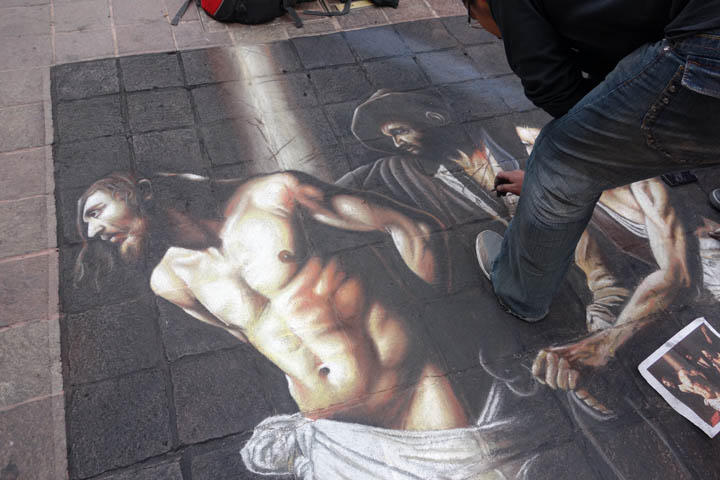
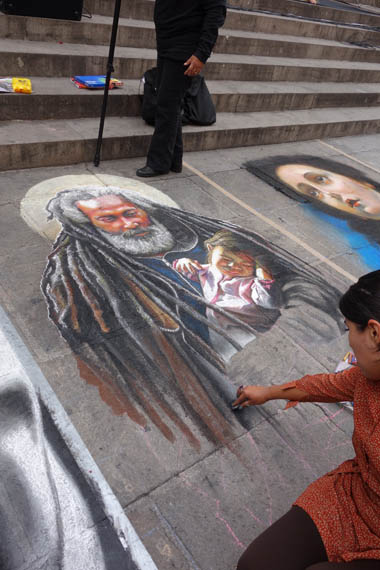
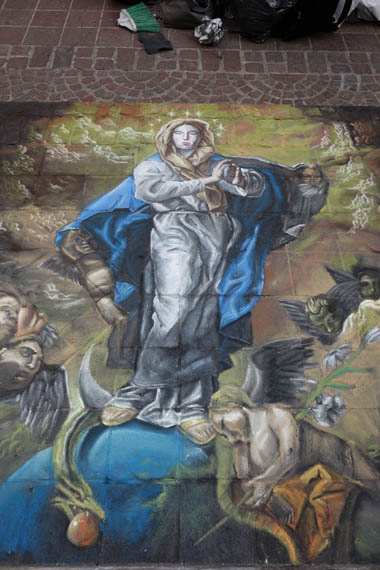
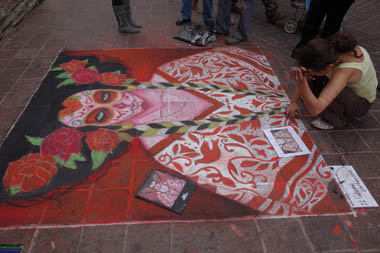
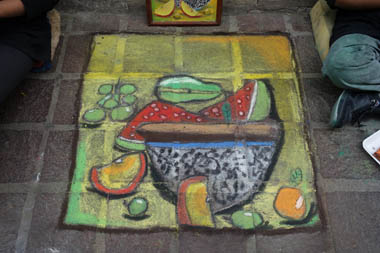
On this occasion it was a
competition of street art performed with a crayon-like pastels made
specifically for this purpose. The photos above and below are just a
handful out of the hundreds we encountered.
|
|
 |
 |
 |
 |
 |
 |
 |
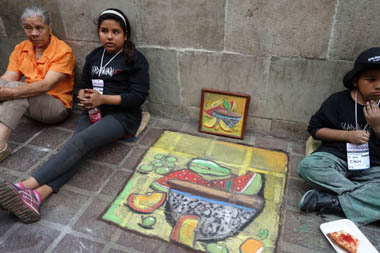 |
| There was even a
whole section dedicated to kids as young as seven and eight years old.
Their work was displayed here with the image that inspired it. |
|
 |
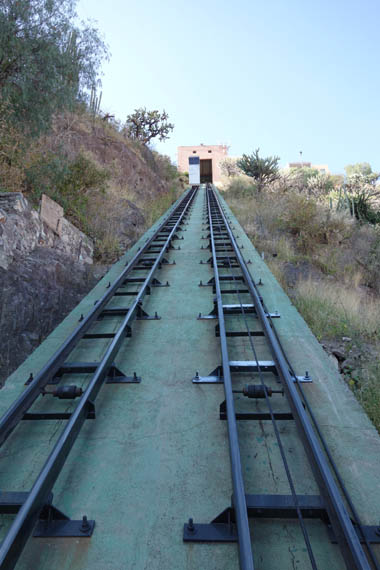 |
| Next to one of
Guanajuato's principle theaters Teatro
Juarez there is a narrow passage that will take you to the
funicular to ride up to the statue of El Pípila. Another of
Gunajuato's many famous structures is the Alhóndiga, a huge
former grain warehouse that dates back to the late 18th early 19th
centuries. It was the sight of the first significant victory of
Mexico's independence fighters over Spanish forces. The Spanish had
converted theAlhóndiga into a fortress, and legend has it that
under orders from Miguel Hidalgo El Pípila tied a stone slab to
his back to protect him from Spanish bullets and was able to set fire
to the doors enabling victory. To really grasp why the battle here at
Guanajuato was so significant you have to understand that Guanajuato is
a 500 year-old town, and for more than 250 of those years it produced
20% of the worlds silver. More than anything the fight for independence
was meant to throw off the yoke of Spanish fiscal control and the
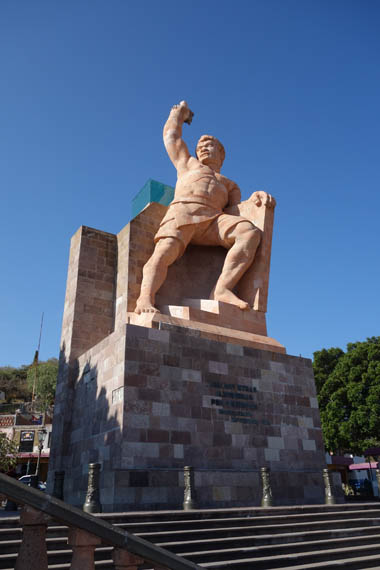
fattening of the king's coffers. The funicular ride brings you to the
base of the statue of El Pípila (below), and provides the
lookout at the rim of the
"bowl" that Guanajuato sits in for the panoramic view at the top of the
page. |
|
 |
|
 |
 |
|
If there is a down side to
Mexico's recent growth in national tourism it is that, while more
Mexican city dwellers are starting to discover their own country, where
you could once find handmade crafts they are rapidly being replaced in
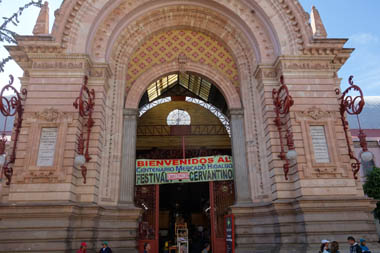
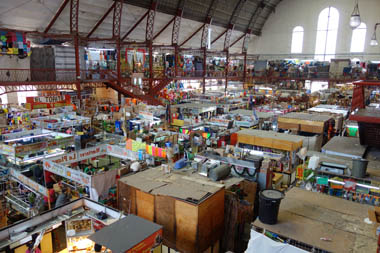
some places by cheap chotchkies. In Guanajuato's elaborate mercado
building (above), however, the real Mexico is still very much alive.
|
|
 |
|
 |
|
 |
|
 |
|